
In the Philippine food and beverage industry, customer choice has never been wider. From neighborhood cafés to fast-growing QSR chains, the rise of food delivery platforms and online food discovery has made it easier than ever for customers to switch brands with just a few taps on their phones.
In this environment, the biggest challenge for many brands is no longer customer acquisition, but retention. It means getting customers to return, order again, and choose the same brand consistently.
Restaurant loyalty programs play a critical role here, not as discount engines, but as tools that reinforce retention without slowing down daily operations. Explore the market factors at play, the mechanics, and features that give this customer engagement tool an edge in driving repeat orders.
The Philippine market is highly promo-driven. Discounts from delivery platforms, limited-time offers, and bundled deals are everywhere. While these tactics may drive short-term traffic, they rarely build long-term customer habits. Brands that rely heavily on promotions often struggle to retain customers once discounts disappear.
According to PwC’s Global Consumer Insights Survey, customers are more likely to return to brands that offer consistent value and personalized rewards, especially in everyday purchases like food and drinks. Research published by Harvard Business Review further shows that increasing retention rates by just 5% can raise profits by 25% to 95%. Driving repeat orders also stabilizes demand, supports better forecasting, and reduces dependence on constant promotions. For F&B operators, loyalty works best when it becomes part of the customer’s routine, not when it functions as a one-time incentive.
According to Deloitte’s research on customer loyalty, the most effective programs are simple, frictionless, and clearly communicated. When loyalty programs are designed around customer behavior, without slowing down service or adding operational complexity, they directly influence how often customers return. For example, businesses like NutriAsia and Cocopan preferred when rewards programs are easy to use, process transactions quickly, and eliminate pain points of traditional business processes. On top of this, Philippine operators should prioritize systems that centralize customer data, and scale easily across branches. Integrated platforms reduce friction and make loyalty programs sustainable over time.
That is why restaurant loyalty programs in the Philippines have evolved from simple punch cards into structured digital tools that help F&B brands boost repeat orders while staying operationally efficient. Below are the loyalty formats most commonly used that check all the boxes:
These remain one of the most effective ways F&B brands boost repeat orders. Customers earn points every time they order and can exchange them for rewards on future visits, creating a natural incentive to return.
Points-based programs remain the most preferred loyalty format globally. For Philippine brands, points-based systems work well across dine-in, takeaway, and delivery channels. Solutions such as RUSH Loyalty Points are a favorite restaurant rewards program, incentivizing repeat orders without relying on constant discounts, helping build habit rather than price sensitivity.
Not all customers contribute equally to revenue. Privilege-based loyalty programs are designed to recognize and retain customers who visit frequently or show strong brand preference.
Privilege cards offer exclusive perks, special benefits, or member-only offers that feel meaningful rather than transactional. Research from Accenture on customer engagement shows that customers are more likely to return when rewards feel highly-personalized and valuable.
Programs such as RUSH Loyalty Privilege Card help brands boost repeat orders by giving loyal customers a reason to choose the same brand repeatedly, even among promo-heavy competition.
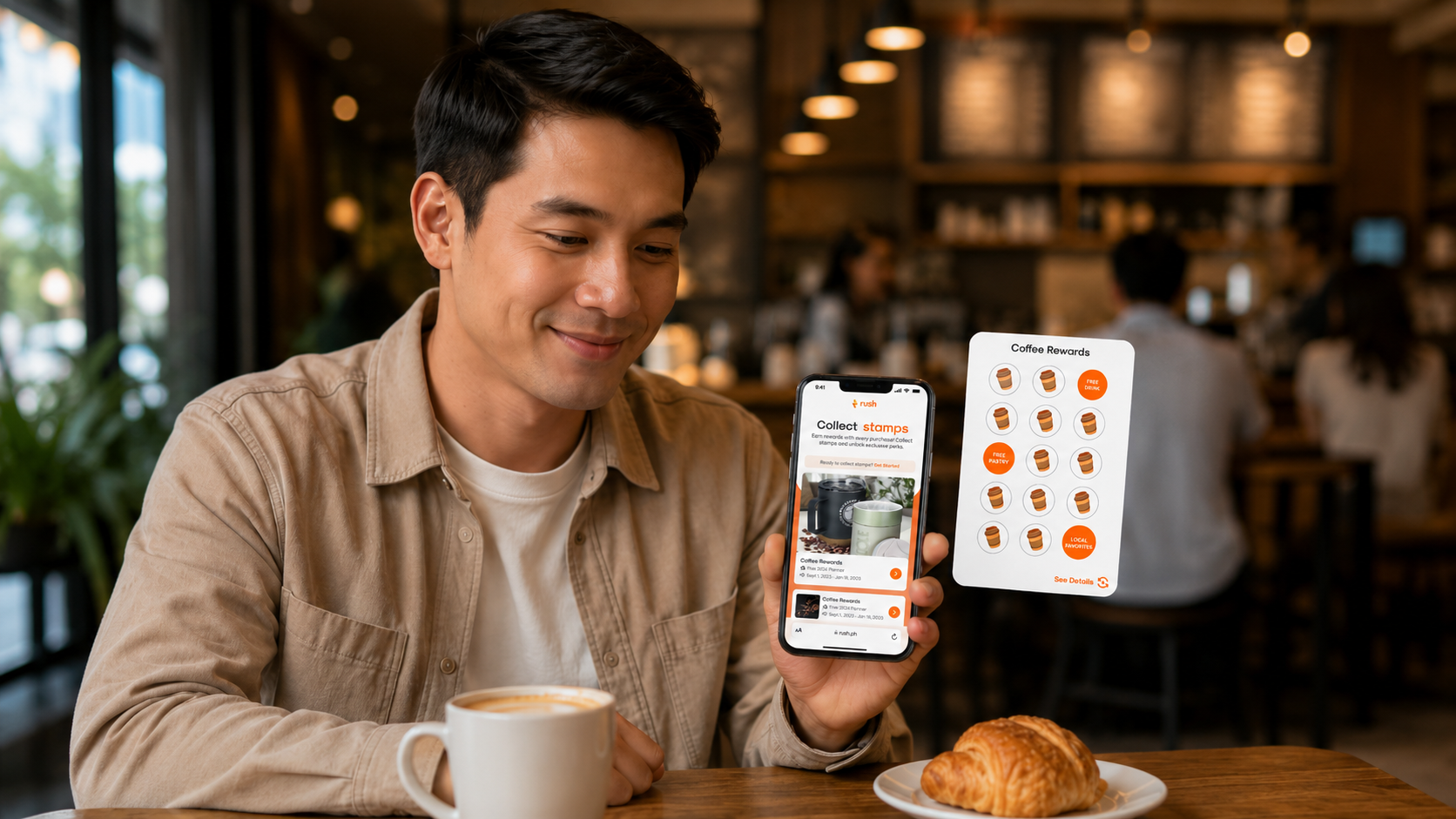
For cafés, bakeries, and quick-service restaurants, visit frequency often matters more than basket size. Punch card loyalty programs reward customers after a certain number of visits, making progress toward rewards gamified and easy to understand.
According to Square’s restaurant loyalty insights, visit-based rewards are particularly effective for high-frequency dining formats. Digital punch cards remove the limitations of paper cards while maintaining familiarity.
Programs such as RUSH Loyalty Punch Card help Philippine F&B brands encourage repeat visits without manual tracking or added friction at the counter.
Top food & beverage brands use loyalty programs to drive repeat orders in their own ways:
This prolific coffee cafe rolled out a loyalty points app, which lets customers accumulate points when they register and with every online and in-store purchase. Earned points can be used to pay for future purchases.
But First, Coffee supplements this with a digital punch card during the holiday season, where customers who’ve earned 15 stamps get a free Holiday Santa Sack filled with limited‑edition goodies - showing how programs can drive store visits and engagement, even in the most competitive seasons.
This international and well-loved froyo brand’s loyalty program is entirely digital. Customers sign up through the Pinkberry PH app or by scanning QR codes in‑store. The brand promises 5 bonus points upon registration, then 1 point for every ₱20 spent at any Pinkberry branch.
Points accumulate in the app and can be redeemed for rewards that appeal to frozen‑yogurt fans: 100 points for a swirly magnet or a small swirl with toppings, 150 points for a medium swirl, 200 points for a large swirl, and 250 points for a take‑home tub. Pinkberry also occasionally runs limited‑time promotions that grant bonus points on special sale days or for specific products, then lets members swap points for branded goodies.
For Philippine F&B brands, loyalty programs are most effective when they are designed to build customer habits versus one-time transactions you would get from constant promotions.
The most successful restaurant loyalty programs increase repeat orders by being easy to use for all, by fitting naturally into daily store operations, and by aligning to customer behavior.
If you’re looking to apply functional, seamless loyalty to your own F&B brand, look no further than RUSH. Book a demo to explore how Points, Privilege Cards, and Punch Cards work together in one integrated loyalty platform built for Philippine food businesses.
Why should food businesses and restaurants invest in a loyalty program?
Loyalty programs build continuous business - repeat customers can contribute up to 40% of a restaurant’s revenue, and diners with rewards are twice as likely to return. By offering perks and personalised incentives, you create reasons and value that keep guests coming back.
What rewards resonate with Filipino diners to drive repeat orders?
To Filipino consumers, personalized rewards that they can consistently access make them feel recognised and valued, and will therefore drive repeat orders.
Can a loyalty rewards program for restaurants drive repeat orders?
Yes. Loyalty rewards programs such as points-based schemes, privilege cards and punch cards encourage customers to return by letting them accumulate and redeem points or enjoy exclusive perks, creating habitual repeat orders across dine‑in, takeaway and delivery channels.
How can F&B businesses start and scale a loyalty program?
Begin with a simple stamp card scheme - collecting a set number of stamps for a free drink is an easy way to test loyalty mechanics. Once you see traction, upgrade to a digital solution like RUSH Punch Card, Points, or even Privilege Card, that integrate with your sales channels, track rewards automatically, and deliver personalized experiences to boost repeat visits.